9 But take care that this freedom of yours does not somehow become a stumbling block to the weak. 10 For if someone sees you, the one who has knowledge, dining in an idol’s temple, will his conscience, if he is weak, not be strengthened to eat things sacrificed to idols? 11 For through your knowledge the ONE WHO IS WEAK IS RUINED, the brother for whose sake Christ died. 12 And so, by sinning against the brothers and wounding their conscience when it is weak, you sin against Christ. 13 Therefore, if food causes my brother to sin, I will never eat meat again, so that I will not cause my brother to sin (1Cor8:9-13)
Conscience – a spiritual faculty
Yet another post concerning conscience and how at the personal level it is supreme over everything, even religious faith or biblical truth. For that is what Paul is effectively saying here and he made a similar point in Rom14 (vv14-23). The weaker brother Paul sites believes that he should not eat meat that has been sacrificed to idols. The truth is that this individual is wrong about the matter as Paul explained at the opening of the chapter.
But what ultimately matters is not whether it is right or wrong, even whether it is biblically true or false, but what the person in question’s CONSCIENCE dictates on the matter. Paul’s language is especially strong: a Christian who defies (and thereby defiles) his conscience is in danger of utter ruin. Observe how the Greek word for lost/destroyed/ruined [ἀπόλλυμι] is used in the bible [You can do so HERE] . You will see this cannot be referring to a Christian merely losing his sense of peace (as some Reformed commentators such as John Gill try to make out). It implies moral ruin and undoes the work for which Christ died (v11), which in the case of the Christian pertains to both pardon and sanctification through personal participation in the life of Christ (Rom5:10). This observation has the profoundest implications: Remember, this “weak believer” has eaten meat he was entirely entitled to eat, yet according to Paul, he is open to ruin [Greek: ἀπόλλυμι] – simply because his conscience has dictated that he should not do so and he has gone against its promptings.
CONSCIENCE AN OBJECT OF FAITH
This may superficially sound like bad news but it has wondrously positive implications, affirming the reality of so-called natural law (in the sense of common/innate spiritual faculties). For surely Paul is touching here upon a universal principle. A functioning conscience is not confined to the Christian but has been provided to all, albeit in the third soteriological category I have identified it fails to function – see earlier post
As Paul writes elsewhere and exactly in this context, WHATEVER IS NOT OF FAITH IS SIN (Rom14:23). By “not of faith” you will observe in that context he is not referring to faith in Christ or the lack of it but adherence or otherwise to the dictates of conscience. For truly, faith at the universal level pertains to the conscience. It is “the law of God written in the heart” (Rom2:15); the light of Christ in the spirit (Jn1:9KJV cf. Mt18:6). The conscience does not reside in the brain, it is a spiritual faculty that functions through it (which is why many psychopaths have been shown to have an underdeveloped pre-frontal cortex for there has been little conscience-related or empathetic activity to process).
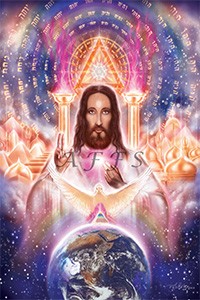
The divinely ordered principles of humane living that this facility provides to the human mind are not derived from sperm or ovaries, they pertain to the God-planted human spirit, ultimately to the incarnate Word Himself: the Cosmic Christ (cf. Jn1:9KJV; Mt18:6). This helps explain the strength of Paul’s language and why conscience is the overriding determinant in what is to be regarded as sinful or acceptable in the sight of God. St John Henry Newman [19th century Evangelical turned Catholic] rightly described the conscience as the universal revelation of God, anterior to the Gospel and supreme over all other human faculties providing everyone with “a clear and sufficient object of faith” [1].
Conscience and the Cosmic Christ
Further, if as Paul writes “whatever is not of faith is sin” then it follows that everything that is not sinful, i.e. actions with which the conscience concurs (for example acts of compassion shown by the Matthew chapter 25 “sheep”) pertain to what God regards as a form of faith. And as that definitive passage on final judgement demonstrates it is “faith” (working through love) that justifies, even when it does not relate to religious belief or practice (which Jesus does not so much as mention). However, it does relate to Christ, through Whom and for Whom all things were created (Heb2:10) – the Son of Man who identifies with the neediest members of the human race and says: ‘Truly I say to you, to the extent that you did (an act of kindness) for one of the least of these brothers of Mine, you did it for Me (Mt25:40).
Such common faith being a direct response to the workings of conscience does not of itself save a person for it does not deal with mankind’s underlying problem being what Paul describes elsewhere as “the body of this death”. The sole remedy for that is a personal relationship with Jesus Christ as Lord and Saviour together with the energies of the Holy Spirit. Such is reserved for those “predestined to be conformed to the image of God’s Son” (Rom8:29). Given that they are destined to be the corporate bride of Christ to rule with Him through eternity and share His throne (Rev3:21), it should be no surprise that a large swathe of humanity does not fall into that category. But neither are that majority the “children of the devil” referred to by Jesus, John and Paul – hateful towards their fellows and devoid of conscience and compassion (Mt25 again). Be aware, such people are often able to charm the birds from the trees, they are not always identifiable by the rest.
Providential implications
All this will make perfect sense once the three soteriological categories I have been systematically adducing from the Scriptures are perceived, together with the vastly broader benign providence that results from such an analysis. And as should be evident from the above, the Cosmic Christ is at the heart of all this, whether it be the Matthew 25 “sheep” who shall be accepted at last into the Father’s Kingdom or the saints who shall reign with Christ through eternity – there is no salvation for anyone apart from Him.
Note
[1] John Henry Newman: “Grammar of Ascent” https://en.wikipedia.org/wiki/Grammar_of_Assent
The LITTLE BOOK OF PROVIDENCE: a seven-part synopsis of the bible: Download a free PDF of e-book suitable for desktop computers HERE [updated September 2023] or a Large-print version for mobiles HERE [565 pages]
Author’s Facebook page HERE
 The Little Book of Providence
8 thoughts on “CONSCIENCE & THE COSMIC CHRIST”
Comments are closed.