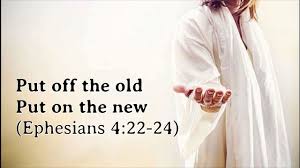
17 So I say this, and solemnly charge you in the Lord, that you are to no longer walk just as the Gentiles also walk, in the futility of their minds, 18 being darkened in their understanding, excluded from the life of God because of the ignorance that is in them, because of the hardness of their heart; 19 and they, having become callous, have given themselves up to indecent behavior for the practice of every kind of impurity with greediness. 20 But you did not learn Christ in this way, 21 if indeed you have heard Him and have been taught in Him, just as truth is in Jesus, 22 that, in reference to your former way of life, you are to rid yourselves of the old self, which is being corrupted in accordance with the lusts of deceit, 23 and that you are to be renewed in the spirit of your minds, 24 and to put on the new self, which in the likeness of God has been created in righteousness and holiness of the truth. 25 Therefore, ridding yourselves of falsehood, speak truth each one of you with his neighbor, because we are parts of one another. 26 Be angry, and yet do not sin; do not let the sun go down on your anger, 27 and do not give the devil an opportunity. 28 The one who steals must no longer steal; but rather he must labor, producing with his own hands what is good, so that he will have something to share with the one who has need. 29 Let no unwholesome word come out of your mouth, but if there is any good word for edification according to the need of the moment, say that, so that it will impart grace to those who hear. 30 Do not grieve the Holy Spirit of God, by whom you were sealed for the day of redemption. 31 All bitterness, wrath, anger, shouting, and slander must be removed from you, along with all malice. 32 Be kind to one another, compassionate, forgiving each other, just as God in Christ also has forgiven you. [Eph4:17-32]
The opening verse describes Paul as “solemnly charging” or “testifying in the Lord” concerning the instruction he is about to impart to the Ephesian Church. He is not merely advising, even exhorting, but requiring that they act in the way he describes, and he does so with the Lord’s personal authority. What his readers must do (as must we if we are true Christians) he summarizes as “putting off the old self” and “putting on the new” (vv22-24). The “old self” pertained to their former way of life as Gentile non-believers. “Bitterness, wrath, anger, shouting, slander and malice” is to be replaced by “kindness, compassion and the forgiveness of others” (vv31-32).
Even the Christian may on occasions be guilty of returning to the former ways of the old self, at which times we grieve the Holy Spirit (v30). But, as Paul affirms here and elsewhere, if there is no substantive change from the old ways to the new, we are not true disciples of Christ, whatever we “believe” or claim to believe – for a disciple is marked out by his endeavours to follow the ways of his Teacher and Master. That is the outworking of genuine faith – not merely “standing in the grace of God” or “believing Jesus died for my sins”. That of itself is not sufficient.
Luther, for one, would no doubt disagree with that last statement. Yet if he truly had understood Paul, he would have become positively apoplectic about the apostle’s teaching that the manner of life and nature that is to be formed in the Christian is “in accordance with God’s own nature” (v24). Still worse, that as Christians we are to be “imitators of God” (opening verse of next chapter).
For Luther firmly believed (indeed had to believe for his theology to work) that God’s nature and character were incomprehensible to man. Alternatively, what love, compassion and fairness meant to man must mean something quite different when applied to his Creator. For particularly in view of the indisputably biblical doctrine of predestination and election, he (not unreasonably) presumed that God could be neither loving, compassionate or fair in any humanly intelligible sense given that He had predetermined that the bulk of humanity were to be condemned to eternal misery – effectively because they had not done what they were innately incapable of doing (cf. Jn6:44).
The problem with that notion (Oh where should one start?) is that, particularly in the Old Testament, God declares Himself to be compassionate, kind and just; One who has “no pleasure in the death of the wicked; but that the wicked turn from his way and live” (Ezek33:11).
The second problem being that man was created in the image of the invisible God – i.e. in accordance with His nature. And in the Christian that once fallen nature is being repaired and restored such that we become more like Christ. In Paul’s language: “For those whom He foreknew, He also predestined to become conformed to the image of His Son” (Rom8:29).
Thirdly, Jesus was the exact representation (εἰκὼν) of the invisible God (Col1:15), even during His earthly ministry (Jn14:8-9). Following Him is how we become “like God in the world” (Eph5:1) – and it is obvious that that cannot pertain merely to pardon, forgiveness and belief, but to sanctification and holy living.
The three soteriological categories
The predestination/divine justice/human free will conundrum, along with virtually other “tension” in Scripture is resolved once it is understood that there are not two but three categories of humanity:
- the elect whom God has called out of the world to be “a chosen people, a royal priesthood, a holy nation, a people for God’s own possession” (1Pet2:9);
- the bulk of humanity who though not “saved” from the corrupting influence of Paul’s “body of this death” (cf. Rom7:24-25), being the “old self” that Paul has been referring to in the featured passage, yet who nevertheless show by their moral restraint and compassion towards others that they are “of God” (1Jn4:7; Mt25:40);
- children of the devil – the twice dead (in flesh and spirit), devoid of conscience, moral restraint, compassion or any compulsion to speak the truth (Jude12; 1Tim4:2; Mt25:45; Jn8:44)
The context of “election”
Within such a tripartite context, election does not refer to who does or does not “go to heaven when you die” (Mt25 sheep/goats passage deals with that, a passage in which religion is not so much as mentioned). Election pertains to who is inaugurated into the Covenant of Promise. Note in the Old Testament, Isaac was elected, his half-brother Ishmael was excluded – both were Abraham’s children, both were circumcised and both had been blessed by God and Abraham.
In New Testament terms, election/predestination pertains to who, through incorporation into the Church, is thereby given the opportunity to (in Paul’s language) embark upon a “race to win the prize of the high calling of God” (1Cor9:24 & Phi3:14). Access to these exclusive covenants (as with Isaac and Paul) is all of grace – acquisition of the prize is assuredly not as Paul’s depiction makes clear. In Jesus’ words it pertains to those who, aided by grace, finally “overcome” (Rev2:7,11,17,26 ch3:5,12,21 ch21:7)
Of course, the proof texts provided above of themselves won’t hack it. What is needed to support such a case is a coherent recapitulation of the whole bible. With God’s help I believe such has been provided in “The Little Book of Providence”, a free PDF of which is available HERE. Regrettably for many, this has involved substantial deconstruction of Luther and to a large extent Augustine, in terms of their theological law/grace/free will distinctives upon which so much of the Western Church (in particular) has come to rely.
But only in so doing can God’s goodness and justice be perceived when applying the reason and perspectives God has given to us as rational creatures. And only then shall the disastrous cosmic outcomes resulting from Augustinian/Lutheran derived theology (both men having rightly affirmed that proportionately few were favourably destined) – be translated in to the munificent broadscale benign providence that God through Christ always had in store for the world and species that He so loves (Rom8:20-21 cf. Rev10).
 The Little Book of Providence
One thought on “PUTTING OFF THE OLD SELF”
Comments are closed.