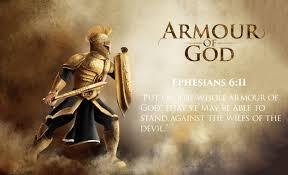
6 Children, obey your parents in the Lord, for this is right. 2 Honor your father and mother (which is the first commandment with a promise), 3 so that it may turn out well for you, and that you may live long on the earth. 4 Fathers, do not provoke your children to anger, but bring them up in the discipline and instruction of the Lord. 5 Slaves, be obedient to those who are your masters according to the flesh, with fear and trembling, in the sincerity of your heart, as to Christ; 6 not by way of eye-service, as people-pleasers, but as slaves of Christ, doing the will of God from the heart. 7 With goodwill render service, as to the Lord, and not to people, 8 knowing that whatever good thing each one does, he will receive this back from the Lord, whether slave or free. 9 And masters, do the same things to them, and give up threatening, knowing that both their Master and yours is in heaven, and there is no partiality with Him. 10 Finally, be strong in the Lord and in the strength of His might. 11 Put on the full armour of God, so that you will be able to stand firm against the schemes of the devil. 12 For our struggle is not against flesh and blood, but against the rulers, against the powers, against the world forces of this darkness, against the spiritual forces of wickedness in the heavenly places. 13 Therefore, take up the full armour of God, so that you will be able to resist on the evil day, and having done everything, to stand firm. 14 Stand firm therefore, having belted your waist with truth, and having put on the breastplate of righteousness, 15 and having strapped on your feet the sure footing of the gospel of peace; 16 in addition to all, taking up the shield of faith with which you will be able to extinguish all the flaming arrows of the evil one. 17 And take the helmet of salvation and the sword of the Spirit, which is God’s declaration (Eph6:1-17).
This is part of Paul’s final recorded address to the Ephesian Church. In terms of vv1-11, the key point is that the Christian, whether a parent or child, servant or master, employee or employer, is ultimately a servant of Christ and must act accordingly. Much of this will have been counter-intuitive in Paul’s day. Many slaves will have hated their master (sometimes with good reason), and so will have performed their duties begrudgingly or at best out of eye-service, in Paul’s language, as “people pleasers”. Many masters of that time will have regarded their slaves as barely human resources to be exploited. Modern working practices are usually somewhat more enlightened, yet even today, the application of these principles as employers or employees can be transformative – a profound witness to the reality of our Faith.
That is especially the case if we actually believe verse 8: “knowing that whatever good thing each one does, he will receive this back from the Lord”. Contrary to the emphasis of certain Christian traditions, our God is a rewarding God. He delights in our doing those things which please Him and repays the practitioner handsomely, occasionally in this life, always in the next.
THE NATURE OF THE FOE
The Christian is enabled to please God in ways that others are not, and that pertains to the spiritual armoury at his disposal. But it is not for human battle, for, says Paul, there is a realm of evil extraneous to humanity; a sophisticated principality of wickedness that endures as a force in the world to the present day:
“Our struggle is not against flesh and blood, but against the rulers, against the powers, against the world forces of this darkness, against the spiritual forces of wickedness in the heavenly places” (v12).
The verse is addressed to Christian believers, but the One who remembers the needs of sparrows is aware that the activity and influence of this evil realm impinges upon the whole human family and all created life. It will appear to many that we arein fact wrestling against flesh and blood, for the diabolical activity that Paul was referring to is largely exercised through the human agencies under its control. These are the human seed the bible variously refers to as the wicked (Old Testament), children of the devil, the compassionless “goats” of Mt25 or the darnel poisoning the wheat that must remain until harvest in Mt13.
Of course, the rest of humanity sins and causes plenty of trouble as well, the more so for being led astray and corrupted by Satan who deceives the world through the people he controls. But God holds Satan rather than mankind personally accountable for the world being in the state it is; he will pay by far the greater price, as will his human agents. Reference is first made to this satanic herd in the protoevangelium (“I will make enemies of you (Satan) and the woman, and of your seed and her Seed – Gen3:15).
This rarely observed (or understood) reference to the devil’s seed applies to an eluded sub-category of the unsaved, whom I systematically delineate applying the whole of Scripture in “The Little Book of Providence”. For, paradoxical as it may appear, an awareness of the satanic forces that Paul is alluding to in our featured passage, along with the individuals under their control, is essential to ascertain the broader benign providence outlined in my book and within these posts.
Author’s Facebook page HERE.
 The Little Book of Providence