4 Therefore, my beloved brothers, whom I long to see, my joy and crown, stand firm in the Lord in this Way, my beloved. 2 I urge Euodia and I urge Syntyche to live in harmony in the Lord. 3 Indeed, true companion, I ask you also, help these women who have shared my struggle in the cause of the gospel, TOGETHER WITH CLEMENT as well as the rest of my fellow workers, whose names are in the book of life (Phil4:1-3)
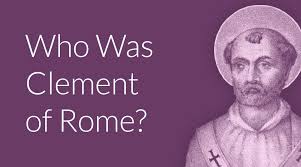
Moving on to chapter four, we cannot be certain that the Clement referred to in this passage was Clement of Rome (aka Pope Clement I – Bishop of Rome, late first century, regarded as the first Apostolic Father), but traditionally that is thought to be the case. Certainly, the Epistle of Clement to the Corinthians is considered one of the earliest known Christian works after the New Testament and was likely written in the late first century.
These posts are primarily concerned with Scripture and its interpretation, but I also make reference to the writings of the earliest Fathers, and what I find is this: I delight in them. Even taken as a whole, the writings of the late first, second and early third Christian writers cannot provide a comprehensive picture of what the early church believed, but what I have found is that the overall tenor of their writing accords with my own biblical interpretations whilst diverging significantly from what I believed for many years as an Evangelical.
Clement and election
So, skimming through Clement’s epistle, which can be referenced HERE, the opening greeting affirms that the Church are those “that are called and sanctified by the will of God, through our Lord Jesus Christ”. That affirms predestination/election – the fact that only those God chooses for Himself are saved; no one has an innate ability to come to Christ for salvation (cf. Jn6:44). Of course, that accords with my former Calvinist beliefs, but unlike the rest of Clement’s teaching, the Reformers’ theology is far removed from the Christmas angels’ declaration of “Good News of great joy that shall be to all people”.
The issue regarding election is context, in particular what the New Testament writers mean by “salvation” (see below). Clement’s opening greeting to the Corinthians is on similar lines to that of Paul’s to the Ephesians: “He chose us in Him before the foundation of the world, that we would be holy and blameless before Him in love. He predestined us to adoption as sons through Jesus Christ to Himself, according to the good pleasure of His will” (Eph1:5).
It follows that many Christians, including myself in the past are effectively saying that those God does not choose to be corporately betrothed to His Son (Rev21:9) and share the throne of Christ (Rev3:21) are bound for Hell. It is ludicrous when one thinks about it and, I have concluded, largely results from Augustine’s interpretation of Paul’s epistles.
So having said I delight in reading the earliest writings of the post-apostolic Church, that cannot apply to Augustine, still less Luther or Calvin – largely in view of what the latter gentlemen write regarding God’s nature (at best, incomprehensible; at worst, barbaric) and the scope of His benign providence, despite sacrificing His Son to save the world that He loves. Clement refers to God’s nature and providence in the context of how the Christian is to imitate God: “Let us be kind one to another after the pattern of the tender mercy and benignity of our Creator” (chapter 14). [Who can imagine Augustine writing that three centuries later?]
Truly, it were better that Christians today do not “imitate God” (Eph5:1) if they understand the Creator to be as Augustine, Luther and Calvin depicted Him. Thankfully, Clement’s God, like mine, “does good to all, but most abundantly to us who have fled for refuge to His compassions through Jesus Christ our Lord, to whom be glory and majesty for ever and ever (chapter 20).
In terms of what God requires of us, Clement’s emphasis is very different from Luther’s: the first century saint warned that Christians, regardless of how strongly they understand themselves to be trusting in Christ, shall be under God’ condemnation “unless we walk worthy of Him, and with one mind do those things which are good and well-pleasing in His sight” (chapter 21).
Clement and justification
So, did Clement affirm justification by faith? Absolutely: “we, too, being called by His will in Christ Jesus, are not justified by ourselves, nor by our own wisdom, or understanding, or godliness, or works which we have wrought in holiness of heart; but by faith” (chapter 32). But clearly not faith alone or indeed anything new-fangled, for he continues, being “that faith through which, from the beginning, Almighty God has justified all men. Likewise Paul in Rom1:17b: As it is written, “The just shall live by faith” Where was it written, when, by whom and in what context? ( Hab2:4) Another post refers.
Order within the Godhead
Clement also affirms the monarchical status of God the Father when he wrote: “The apostles have preached the gospel to us from the Lord Jesus Christ; Jesus Christ [has done so] from God. Christ therefore was sent forth by God, and the apostles by Christ. Both these appointments, then, were made in an orderly way, according to the will of God” (chapter 42). Clement along with most of the earliest Fathers were deemed by the post-nicene Church to be “subordinationist” with regard the Lord Jesus Christ’s status. But he was only reflecting Paul’s own teaching that “there is only one God – the Father, FROM whom are all things, and we exist FOR Him; and one Lord – Jesus Christ, BY whom are all things, and we exist THROUGH Him” (1Cor8:6) [see also 1Cor11:3 cf. Rev1:1].
I have to raise this thorny issue as it is necessary to understand some of the concepts I have been outlining, not least regarding Paul’s reference in Eph3 to the secret plan that had been hidden in God from previous ages – and therefore from pre-apostolic prophets, and I mean all of them (cf. Mt3:7; Mt10:23; Mt16:28). Only then shall Rom11 vv11,12,15 and 30 be taken seriously, by which I mean literally😲, the providential and dispensational implications of which are gigantean (see also Acts11:17-18).
Other Pauline appointees
Even if Paul’s Clement is not the author of the epistle to the Corinthians, consider such biblical personages as Timothy (c. AD17-97), Titus (c. AD13-107) and Philemon (timeline uncertain) to whom Paul wrote epistles and envisage the numerous and worthy men they in turn will have appointed to continue the ministry in accordance with Paul’s instructions. Then, reflect on the second century Church and its writers and perceive that it is quite impossible that all recorded witnesses from that era could have been in error concerning vital aspects of gospel truth. For 2nd century Irenaeus’ testimony affirmed that the churches at that time had a reasonably uniform understanding of the essentials of the faith. An earlier post refers
And historian Eusebius who chronicled their beliefs and practices (same post) affirmed that the 2nd/3rd century Churches’ understanding of free will, natural law, anthropology and the economy of grace are along the lines of what I have been setting out rather than Augustine’s narrower fatalistic position that the Western Church (in particular) went on to utilize, unavoidably demeaning God’s magnanimous salvific program that He has accomplished through our Lord Jesus Christ.
 The Little Book of Providence
One thought on “CLEMENT – NOTABLE CO-WORKER WITH PAUL”
Comments are closed.