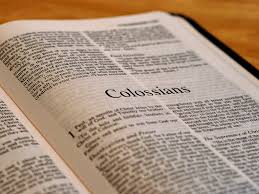
15 (Christ) is the image of the invisible God, the firstborn of all creation: 16 for IN Him (not BY Him – some versions) all things were created, both in the heavens and on earth, visible and invisible, whether thrones, or dominions, or rulers, or authorities—ALL THINGS have been created THROUGH Him and FOR Him. 17 He is before all things, and in Him all things hold together. 18 He is also the head of the body, the church; and He is the beginning, the firstborn from the dead, so that He Himself WILL COME TO HAVE FIRST PLACE IN EVERYTHING. 19 For it was THE FATHER’S GOOD PLEASURE for all the fullness to dwell in (Christ), 20 and through Him to reconcile all things to Himself, whether things on earth or things in heaven, having made peace through the blood of His cross (Col1:15-20)
Moving on to Colossians, this is the Apostle Paul’s portrayal of the Lord Jesus Christ. The true picture is reflected in His name/title:
i) “LORD”, refers to His pre-eminence over everything that has been created – “the firstborn of all creation” (v15). Paul (and indeed John when describing the pre-incarnate Logos) are careful in their use of prepositions to depict the LJC/Logos as the One IN (ἐνG1722) whom and THROUGH (διάG1223) whom and FOR ( εἰςG1519) whom all things were created. [Not strictly BY whom – that was the Father].
ii) “JESUS” refers to His Saviourhood; and note the universality/cosmic nature of God’s purposes in Christ: “through Him to reconcile ALL THINGS to Himself, whether things on earth or things in heaven, having made peace THROUGH THE BLOOD OF HIS CROSS (v20). Yet by no means do all men and women have a personal interest in that blood, which is necessary for salvation. For in Paul’s language they had not been “predestined to become conformed to the image of His Son”. Indeed, proportionally very few shall (in Paul’s language again) “attain the prize of the high calling of God”. And that applies even to those within the Church as Revelation suggests (e.g. 3:4). And yet, sticking with Paul, “the CREATION ITSELF is to be be set free from its slavery to corruption into the freedom of the glory of the children of God” (Rom8:21).
iii) “CHRIST” is not a surname but another title: God’s Anointed One.
Providential implications
But how are the above seemingly divergent prospects for humanity to be reconciled? It comes back to our featured passage concerning who the Lord Jesus Christ is. Paul describes Him as the firstborn, being the most ancient, supreme leader and representative of all that has been created. It would surely be surprising if the bulk of what God has created IN His Son and FOR His Son was destined for the cosmic wastepaper basket.
It is no wonder (and I believe was foretold in Scripture) that confusion has arisen. For it is indeed the case that for the present God has exclusively chosen “a royal priesthood, a holy nation, a people for God’s own possession”(1Pet2:9), just as He did with the Jews in the Old Testament (Ex19:6). And largely thanks to how the mighty Augustine came to interpret Paul’s epistles in the 4th/5th century, the understanding, more particularly in the Western Church, has prevailed that, according to the bible, everyone else can go to Hell. As Augustine more diplomatically expressed this providential dilemma: “God willed that many more are left under punishment than are delivered from it, so that it may thus be shown what was due to all [1]
In order that God’s munificent providence can be shown for what it is, rather than something to be derided within a Monty Python sketch [2], it has been necessary systematically to deconstruct the distinctive teachings of Augustine and those such as Luther and Calvin who built upon them. I am doing so to the best of my ability in these posts, in my 95 theses and more comprehensively in The Little Book of Providence.
Citations
[1] Augustine “De Civitates Dei” XXI chapter 12
[2] Recitative: “Oh Lord, please don’t burn us, don’t grill or toast your flock” [Cleese, Gilliam, Idle, Chapman, Jones] Courtesy “The Meaning of Life” (1983)
צְחָ֔ק
The LITTLE BOOK OF PROVIDENCE: a seven-part synopsis of the bible: – available as a paperback from Amazon or FREELY as a PDF file HERE.
Author’s Facebook page HERE
Examine the website at THE LITTLE BOOK OF PROVIDENCE HOME PAGE
 The Little Book of Providence