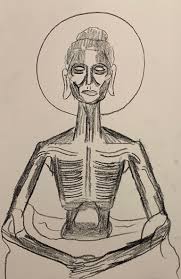
20 “If you have died with Christ to the elementary principles of the world, why, AS IF YOU WERE LIVING IN THE WORLD, do you submit yourself to decrees, such as, 21 “Do not handle, do not taste, do not touch!” 22 (which all refer to things destined to perish with use)—in accordance with the commandments and teachings of man? 23 These are matters which do have the appearance of wisdom in self-made religion and humility and severe treatment of the body, but are of NO VALUE AGAINST FLESHLY GRATIFICATION”. [Col2:20-23]
Not for the first time, there are aspects of Paul’s teaching here that might at first appear curious (highlighted in capitals) – less so once certain translational and soteriological aspects are clarified. The first eyebrow raiser is the apostle’s phrase “as if you were living in the world”. Are we not living in the world? NO, not if we are Christians – we are no longer to live “ἐν κόσμῳ” – usually translated as “in the world” but as Biblehub rightly affirms κόσμος is referring to an ordered system, aka the world order, with its various governing and moral principles – Paul’s “elementary principles of the world” (v20).
For sure, Christians presently live on planet Earth and are to delight in it and care for it. They along with the rest of humanity are God’s viceregents and stewards of the planet – a wondrous entity which evinces God’s glory and has been created through Christ. But whilst (thankfully) some divinely ordered principles are upheld by worldly authorities, not all are, and that is certainly the case in the religious sphere.
The latter is what Paul is referring to here when he writes “These are matters which do have the appearance of wisdom in self-made religion and humility and severe treatment of the body”. Verse 21 indicates he is particularly referring to what is eaten and drunk – for the Christian there are no prohibitions (in terms of substance, excess is another matter – Eph5:18). Such freedoms need to be balanced with what Paul writes elsewhere about disciplining his body (1Cor9:27). But clearly, he cannot be referring in Corinthians to an extreme form of asceticism, for here he is cautioning against “severe treatment of the body”.
That brings us on to the other surprising statement, that such bodily discipline has “no value against fleshly gratification” (v23), for logically, one would expect that it might. But that is to confine what Paul means by “fleshly gratification”. Paul explains what he understands by “the flesh” in Rom7:14-25, which contrary to most commentaries is not referring to Paul as a Christian. Early Church theologians uniformly recognized that fact, but Augustine’s take on original sin and human depravity helped change that interpretation, for the post-Augustinian Church has difficulty believing that man by nature could ever “delight in the law of God in the inner man“. Yet I showed in the previous posts that in no way would Paul the Christian have regarded himself as a slave to sin, incapable of doing what is right, constantly giving in to the desires of the flesh, like the person depicted in Rom7 – that would thoroughly contradict what he goes on to write in the next chapter, not just concerning himself but every true Christian has been empowered to overcome the fleshly nature.
The related point in the context of the current passage is that Paul’s reference to fleshly gratification is not just relating to acts of the body but to those of the mind also. For the “body of this death” referred to in Rom7 pertains not just to the “bodily members”, but the brain through which the senses are processed. One can discipline one’s body and deprive oneself of food and drink to the point of extreme asceticism, yet in one’s mind have a heart that is bitter, hateful and resentful towards other people, even towards God Himself.
As Paul stated in the earlier passage regarding the worship of angels and false humility, people who advocated such practices were “not holding firmly to the Head, from whom the entire body, being supplied and held together by the joints and ligaments, grows with a growth which is from God. It is important to reiterate, Paul is not saying there is no need for self-discipline: “I strictly discipline my body and make it my slave, so that, after I have preached to others, I myself will not be disqualified” (1Cor9:27). But especially in view of Col2, this cannot be referring to any extreme form of asceticism. It refers not so much to physical deprivation and abstinence, but to resisting the aforementioned sins of the mind, enabled by the spiritual resources at the believer’s disposal providing he or she “holds firmly to the Head”, which is Christ.
Examine the website at THE LITTLE BOOK OF PROVIDENCE HOME PAGE
 The Little Book of Providence