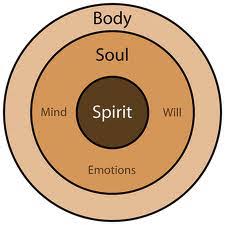
23 Now may the God of peace Himself sanctify you entirely; and may your SPIRIT AND SOUL AND BODY be kept complete, without blame at the coming of our Lord Jesus Christ. 24 Faithful is He who calls you, and He also will do it. 25 Brothers and sisters, pray for us. 26 Greet all the brothers and sisters with a holy kiss. 27 I put you under oath by the Lord to have this letter read to all the brothers and sisters. 28 May the grace of our Lord Jesus Christ be with you (1Thes5:23-28).
The preceding passage which can be read HERE concerned Christian conduct, but as ever I am focussing on texts which have particular relevance to the matter in hand, being the breadth of God’s benign providence. From a human perspective, divine providence could be said to start with how God made us, more particularly what He made us to be, namely (and astonishingly) beings made in His own image (Gen1:26]. So, if the Creator were a man, that is what we would be and always should be, but He is not a man but a deity. Although it is something I (typically) gave little or no thought to in my Evangelical days, our destiny is quite reasonably theosis, or as the Western Church refers to it, divinization. But then there is “the Fall”, so, doesn’t that put paid to that plan, albeit it was God’s sovereign wish? No, our God is not a Loser – Satan did not get the better of Him at Eden.
As I explain in my book, Satan fell for a trap. Maddened by God’s plan to elevate the sons of earth to heights potentially surpassing that of angels like himself, Lucifer rebelled and went on unwittingly to help provide the means for that to be accomplished – through his seeming victory at Eden! That started with the need for God’s only begotten Son to act as humanity’s Saviour by being incarnated as a Man. It is a Man not an angel that has been incorporated into the Godhead, and that Man regards His human followers as His own kith and kin (Heb2:11) and His corporate Bride who shall one day share His throne (Rev19:7 &3:21). But there is another reason why fallen man living in fallen world is destined for such unimaginable glory, and again Satan and his domain have unintentionally provided the agency. For there are two related and eternal principles: He who is to lead must first serve; they who are to be glorified must first suffer (Rom8:17&20 / Heb2:10) . The Lord Jesus Christ set the pattern on both counts.
I may appear to have digressed from the subject of this post, but it sets the scene as to why men and women have been composed as they are, comprising body, soul and spirit – the latter component being the very essence of God, as even Genesis suggested:
And the Lord God formed man of the dust of the ground, and breathed into his nostrils the breath of life; and man became a living soul (Gen2:7).
And in terms of human procreation, Scripture supports the creationist:
The dust will return to the earth as it was, and the spirit will return to God who gave it (Eccles12:7).
In terms of the tripartite nature of man that Paul refers to in 1Thes5:23, Wikipedia provides a good background to how the subject has been understood and developed by the churches through the centuries HERE. In addition, you can see what I wrote more briefly on the subject in The Little Book of Providence below:
************
Primarily through Augustine’s influence and his prosecution of the Pelagian controversy, the post-Nicene Church defected from the orthodox tripartite understanding of most earlier Fathers who believed man to be comprised of body, soul and spirit; the latter being provided directly from God and the means by which one receives sound reason and a pure conscience, the Light of Christ by which little children cannot but “believe” in Jesus the Word (Mt18:6). This has exacerbated difficulties when interpreting Paul’s epistles; the “spirit” not being conceived by most readers to be a separate entity (a component of human nature) distinct from the Holy Spirit.
Paul refers more frequently than others to the human spirit because of his substantial handling of the inner struggle concept, especially in Roman chapter seven. On one occasion he refers to body, spirit and soul together (1Thes5:23) in terms of them being sanctified as a whole. Likewise, the writer to the Hebrews speaks of the word of God penetrating between soul and spirit as it does between the joints and marrow (Heb4:12). The latter two materials of the body are closely related yet distinct, as are the soul and spirit. Justin Martyr spoke of the soul housing the spirit just as the body houses the soul[1] the latter being a kind of ethereal interface formed in the outline of the body enclosing the spirit – invisible when it leaves the body at death yet clearly visible in the realm it inhabits prior to resurrection (cf. Lk16:23).
Irenaeus concurred: the soul possessing the figure of the body in which it dwells[2] whilst “the complete man is composed of flesh, soul and spirit. One of these does indeed preserve and fashion the man – this is the spirit; whilst as to another it is united and formed – that is the flesh; then comes that which is between the two – that is the soul which sometimes when it follows the spirit is raised up by it but sometimes it sympathises with the flesh and falls into carnal lust“[3]. In the New Testament the Greek word for soul (psuche) is sometimes translated as “life” for it more often relates to the physical: “Take no thought for your “psuche” what you shall eat or what you shall drink” (Mt6:25) [Excerpt from The Little Book of Providence chapter two]
*************
The above was written in the context of the chapter that concerned “original sin” – the key point being made thereafter that the source of human sin was the body (including the brain), not the God-given spirit that “incorporates” the conscience. The spirit (in view of its divine Origin) is the source of every good desire and inclination that fallen man possesses whereas the flesh (again in view of its origin – fallen Adam) often opposes God’s law, wishing to please only itself. That tension/dichotomy is what Paul is referring to in Rom7. Relatedly, God’s Holy Spirit is a Facilitator not a faculty – for example, it is the believer who must “put to death the deeds of the body” (Rom8:13) by following the instincts of the spirit rather than the flesh, as per Irenaeus’ depiction above. In other words, salvation is not all of grace but is aided by grace, the believer being empowered by the Holy Spirit and indwelling Christ.
That is so that the people God has chosen for His Son, having disciplined their lives in accordance with His teaching, shall be ready to play an immediate and intimate part in the Kingdom to be established under Christ at His coming. The vast majority will not be in that category, but possessing the spirit (albeit not the Spirit), they instinctively know what is good, right and noble. And Jesus Christ being the living embodiment of such qualities will draw all true humanity to Himself, especially once it has been clarified what he has done on their behalf. As ever, there will be a third grouping, devoid of a functioning spirit and working conscience who hate what is good and so will refuse to bow the knee to Christ at His appearing. As Paul would later write to the Thessalonians, affirming the three categories I have been adducing: “(These wicked) shall be punished with age-enduring destruction from the presence of the Lord, and from the glory of His power; when (Christ) shall come to be glorified in His saints, and to be admired in all them that believe on that day, just as our testimony among you was believed” (2Thes1:9-10).
CITATIONS
[1] Justin on the resurrection chap. 10
 The Little Book of Providence