Paul, an apostle of Christ Jesus according to the commandment of God our Saviour, and of Christ Jesus, who is our hope,2 To Timothy, my true son in the faith: Grace, mercy, and peace from God the Father and Christ Jesus our Lord.3 Just as I urged you upon my departure for Macedonia, to remain on at Ephesus so that you would instruct certain people not to teach strange doctrines 4 nor to pay attention to myths and endless genealogies, which give rise to useless speculation rather than advance the plan of God, which is by faith, so I urge you now. 5 But the goal of our instruction is love from a pure heart, from a good conscience, and from a sincere faith. 6 Some people have strayed from these things and have turned aside to fruitless discussion, 7 wanting to be teachers of the Law, even though they do not understand either what they are saying or the matters about which they make confident assertions.8 But we know that the Law is good, if one uses it lawfully, 9 realizing the fact that law is not made for a righteous person but for those who are lawless and rebellious, for the ungodly and sinners, for the unholy and worldly, for those who kill their fathers or mothers, for murderers, 10 for the sexually immoral, homosexuals, slave traders, liars, perjurers, and whatever else is contrary to sound teaching, 11 according to the glorious gospel of the blessed God, with which I have been entrusted .12 I thank Christ Jesus our Lord, who has strengthened me, because He considered me faithful, putting me into service, 13 even though I was previously a blasphemer and a persecutor and a violent aggressor. Yet I was shown mercy because I acted ignorantly in unbelief; 14 and the grace of our Lord was more than abundant, with the faith and love which are found in Christ Jesus. 15 It is a trustworthy statement, deserving full acceptance, that Christ Jesus came into the world to save sinners, among whom I am chief. 16 Yet for this reason I found mercy, so that in me as the chief of sinners Jesus Christ might demonstrate His perfect patience as an example for those who would believe in Him for eternal life (1Tim1:1-16)
Moving on, Paul now writes to one he describes as his “son in the faith” (v2), Timothy (timeline c. AD17-97), so not that much younger than the apostle. He firstly encourages him to instruct certain believers not to be distracted with speculative theories, genealogies and myths. This project potentially lends itself to such distractions which I try to avoid, although there is one genealogy I’ve drawn attention to in an earlier post taken directly from the Old Testament, for it does have implications to the broader benign providence being presented, i.e., the post-diluvian patriarchs. But with Paul, the ultimate goal of my considerations should be that the disciples of Christ (who as a first step need to be re-united) come to possess “love from a pure heart, from a good conscience, and from a sincere faith” (v5). That is some way removed from depictions I hear, especially but not exclusively from Evangelicals, of the Church being essentially “an assembly of justified sinners”.
The churches Paul founded or pastored he wished (indeed required) to be like the church of Rome in his day “full of goodness, filled with all knowledge and able to admonish one another (Rom15:14). In starkest contrast, Luther once made the assertion that “if men only believe enough in Christ they can commit adultery and murder a thousand times a day without periling their salvation”[1]. No doubt some intended hyperbole on the Reformer’s part, but it is about as far removed from Pauline Christianity as it is possible to get.
Context of Paul’s self assessment
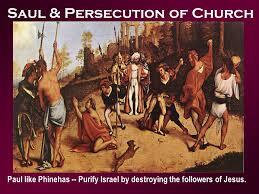
Such misconceptions have been re-enforced by misrepresentations of what Paul goes on to write in this chapter describing himself as “the chief of sinners”. It should be perfectly obvious from the narrative that the apostle is referring to his pre-conversion life as persecutor-in-chief of the infant Church of Jesus Christ. Again, that reinforces the point made in the previous post that Paul’s calling like everyone else’s was all of grace. Who could innately be less worthy of salvation than the chief persecutor of Christ’s Body?
The apostle’s new nature
That was Saul of Tarsus, but in terms of Paul the apostle, “Our exalting is in the testimony of our conscience, that in holiness and godly sincerity, not in fleshly wisdom but in the grace of God, we have conducted ourselves in the world” (2Cor1:12). For once called, that is where the all-of-grace paradigm ends, otherwise Paul will have effectively wasted his breath and ink. As in the previous post, Paul does not merely exhort, he commands regarding the need for holy living(2Thes3:6). Later in 1Tim1 he writes of those who have “shipwrecked their faith” (v19) – shipwrecks are rarely salvable.
God’s true nature
As I have been emphasizing, those who become joint heirs with Christ, whilst rewarded beyond measure or deservedness, must necessarily have contributed to their glorious estate, sharing in the suffering of their Co-heir (Rom8:17). I thank God indeed that final salvation is not all of grace. The Creator is magnanimous for sure, but He is also fair to all. As third century Origen intimated, God even punishes with good intentions in mind; “a just and good God in that He confers benefits justly and punishes with kindness; since neither goodness without justice nor justice without goodness can display the real dignity of the divine nature”[2]. This summarizes in one sublime sentence everything I am seeking to impart concerning our Creator and his Christ.
Doctor of grace or calamitous colossus?
A century or so later, Augustine, largely through his interpretation of Paul, his fierce conflict with Pelagius and (above all) his unprecedented clout, ensured such deific munificence was turned on its head. From any reasoned human perspective God’s nature became barbaric, His plans for humanity a cosmic horror show[3], whilst men and women were deemed to be innately depraved, incapable of “any good thing, whether in thought or will, affection or in action[4]. Such demonstratively perverse anthropology and derogation of what Paul refers to in our passage as “the glorious gospel of the blessed God” (v12) is why this process has had to involve a deconstruction of virtually every distinctive doctrine of Augustine. I emphasize “distinctive” for substantial elements of that (humanly speaking) aptly named Bishop’s teaching were sound, orthodox and supremely erudite. No wonder it is said to this day, “If Augustine taught it, it must be so”. So here we all are.
To follow
In terms of how Paul dealt with those within the Church who disregarded his moral teaching, the apostle’s method was surprising and frankly mystifying for many (v20) – to be covered in the next post.
CITATIONS
[1] Am I making this up? – Copy the quote and paste in Google and you’ll see Luther actually suggested this together with what his supporters thought about it
[2] Origen de Principiis Book II chap. 5 para3
[3] The City of God Book XXI http://www.newadvent.org/fathers/120121.htm
[4] “On Rebuke and Grace” chapter 3
 The Little Book of Providence