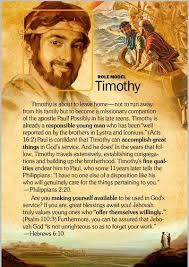
(Timothy), my child, be empowered by the grace that is in Christ Jesus. 2 The things which you have heard from me in the presence of many witnesses, entrust these to faithful men who will be able to teach others also. 3 Suffer hardship with me, as a good soldier of Christ Jesus. 4 No soldier in active service entangles himself in the affairs of everyday life, so that he may please the one who enlisted him. 5 And if someone likewise ++competes as an athlete, he is not crowned as victor unless he competes according to the rules. 6 The hard-working farmer ought to be the first to receive his share of the crops. 7 Consider what I say, for the Lord will give you understanding in everything. Remember Jesus Christ, risen from the dead, descendant of David, according to my gospel, 9]for which I suffer hardship even to imprisonment as a criminal; but the word of God is not imprisoned. 10 For this reason I endure all things for the sake of the elect, so that they also may obtain the salvation which is in Christ Jesus and with it eternal glory (2Tim1-10).
Moving on to 2Timothy chapter 2,, in the opening passage Paul reinforces what I have been emphasizing in recent posts concerning the active role of the Christian – in order that “they also may obtain the salvation which is in Christ Jesus and with it eternal glory” (v10). The Christian is to be like a soldier (v4), an athlete competing for a prize (v5 cf. 1Cor9:24) and a hardworking farmer (v6).
But the main point I want to make concerns the likes of Timothy himself and men like him. Paul instructed the one he regarded as his spiritual “child” (v1) to “entrust (his teaching) to faithful men who will be able to teach others also”(v2). Such a didactic principle has implications that as a former Evangelical I gave little thought to, yet in view of Church history it is a vital consideration in determining whether or not we are standing in the Truth. I will quote from my book capitalizing those phrases that most pertain to the issue:
“One needs to reflect upon the MISSIONARY JOURNEYS OF PAUL in the middle of the first century: their geographical extent and the numerous individuals that would have been appointed by Paul and his fellow missionaries. Firstly, consider such biblical personages as Timothy (c. AD17-97), Titus (c. AD13-107) and Philemon (timeline uncertain) to whom Paul wrote epistles, and envisage the numerous and worthy men they in turn will have appointed to continue the ministry in accordance with Paul’s instructions. Finally, reflect on the second century Church and its writers and perceive that it is quite impossible that ALL KNOWN WITNESSES FROM THAT ERA COULD HAVE BEEN IN ERROR concerning the essentials of gospel truth. For 2nd century Irenaeus’ testimony (below) affirms the churches at that time had a reasonably uniform understanding of the essentials of the faith:
“The Church having received this preaching and this faith although scattered throughout the whole world yet as if occupying one house carefully preserves it. She also believes these points of doctrine just as if she had one soul and one and the same heart and proclaims and teaches them and hands them down with perfect harmony as if she only possessed one mouth. For the churches which have been planted in Germany do not believe or hand down anything different, nor do those in Spain or Gaul. . . But as the sun, that creature of God is one and the same throughout the whole world, so also the preaching of the truth shines everywhere and enlightens all men that are willing to come to a knowledge of the truth [Irenaeus against heresies Book I chap. 10 para 2]
Even if such a report of ecclesiological unity were exaggerated, the point is surely made: the essentials of gospel salvation were known and taught by the second and third century churches. We may therefore SAFELY REGARD ANTE-NICENE TEACHING AND PRAXIS AS NORMATIVE, at least FOR MATTERS ESSENTIAL TO GOSPEL SALVATION, allowance being made for a progressive deepening and maturing of the faith over time through the action of the Holy Spirit and the collective sense of the faithful. But any subsequent progressive revelation cannot pertain to the requirements for gospel salvation: its means of initiation and any essential provisions for ongoing sanctification.
Given that it was not until the fourth or fifth century that theology was moulded into any precision and doctrines were systematised utilizing a relatively recently agreed plenary canon of Scripture, the particular interpretations that Late Antiquity exegetes came to when interpreting the abstruse pastoral letters of Paul in particular needed to have been tested against the universal witness of the immediate post-apostolic Fathers. For the latter had not been entirely reliant upon the precarious process of biblical exegesis using texts written in a language with which the Latin Fathers in particular were unfamiliar.
The faith “once for all delivered to the saints” had been received by them either from the apostles themselves or direct appointees such as Timothy. What they had received must have incorporated ALL OF PAUL’S TEACHING THAT WAS ESSENTIAL TO THE PRACTICE OF THE FAITH. It follows that there can be nothing essential to gospel salvation that could be discovered, recovered or re-interpreted by Augustine or any of his successors four centuries later, let alone fifteen centuries later by the Protestant Reformers. It is quite impossible that the second and third century churches could have been uniformly in error concerning such matters as the nature of repentance (that it pertained to moral reform, not acknowledging oneself to be morally bankrupt and hateful to the core) or the economy of grace (that God had provided certain spiritual faculties to fallen man: natural precepts by which he had effectual free will to desire and do some good such as exercise compassion and practice justice, albeit not to be raised to eternal life apart from gospel grace).
It will have been necessary to understand these matters, not only to discern the true essence of human nature and the disposition required for saving faith, but ALSO TO GIVE THE CREATOR DUE PRAISE FOR HIS GRACIOUS MAGNANIMITY TOWARDS THE HUMAN RACE. [Excerpt from The Little Book of Providence chapter five (progressive revelation).]
 The Little Book of Providence