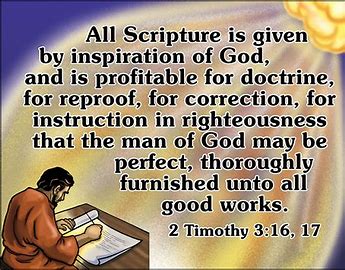
14 You (Timothy), however, continue in the things you have learned and become convinced of, knowing from whom you have learned them, 15 and that from childhood you have known the sacred writings which are able to give you the wisdom that leads to salvation through faith which is in Christ Jesus. 16 All Scripture is breathed out by God and is beneficial for teaching, for rebuke, for correction, for training in righteousness; 17 so that the man of God may be proficient, equipped for every good work (2Tim3:14-17).
Firstly, one should consider what were the sacred writings (ἱερὰ γράμματα) that Timothy would have known from his childhood. Of course, they cannot have been what all Christians today most rely upon, being the New Testament. None of its writing would have even been penned when Timothy (17-97AD) was a lad. So Paul would have been referring to the Old Testament, and contrary to what I once believed as a Protestant, that would have been 46 books including deuterocanonical writings such as Tobit, Judith, Maccabees and Wisdom.
The latter should be regarded as canonical Scripture for although (unlike Enoch – to follow) it may not be directly quoted in the New Testament, teaching and sayings from it are alluded to, including some by Jesus Himself (see list at Note #1). These books, included within the Catholic and Orthodox bibles, were also used as proof texts by the early Church Fathers (including the mighty Augustine, beloved by Protestants). Much more could be said on the composition of the biblical canon and the concept of “sola scriptura”- and it has been in chapter five of The Little Book of Providence (accessible below).
Defining “Scripture”
Paul describes Scripture as literally being “breathed out by God” (Greek: θεόπνευστος). This is obviously not dictation, rather what is written is as it were infused with divine breadth. The writer will express himself in his own words and style, such that what Paul writes is generally recognized as distinctly “Pauline”. The letter to the Hebrews is deemed by most authorities not to be written by Paul, partly for that reason.
But did Paul regard himself as actually “composing Scripture”? Unlikely, rather he was composing pastoral letters, albeit they certainly contained divinely authoritative statements and commands, for he declared them to be so. However, his fellow apostle Peter did effectively define Paul’s writings as Scripture when he wrote: “as in all (Paul’s) letters, speaking in them of these things, in which there are some things that are hard to understand, which the untaught and unstable distort, as they do also the rest of the Scriptures, to their own destruction” (2Pet3:16)
The book of Enoch
Finally on this subject, what about the book of Enoch? I have referred to it on many occasions, for although I am clear it should rightly have been excluded from the canon, I am equally clear that it comes under the category of what Paul referred to as “sacred writings” (v15) that have been divinely inspired. For Enoch contains prophecies, many of which have come to pass, whilst some may be happening right now😲. This earlier post refers.
NOTE #1 – EXAMPLES OF DEUTEROCANONICAL REFERENCES/ALLUSIONS
- Matthew 6:14-15 and Sirach 7:14
- Matthew 27:43 and Wisdom 2:15,16
- Luke 6:31 and Tobit 4:15
- Luke 14:13 and Tobit 4:7
- John 10:22 and 1 Maccabees 4:59
- Romans and Wisdom, clay and the potter
- Romans 11:34 and Wisdom 9:13
- 2 Corinthians 9:7 and Sirach 35:8
- Hebrew 1:3 and Wisdom 7:26
- Hebrews 11:35 and 2 Maccabees 7:7
“The Little Book of Providence” – a prophetically inspired seven-part synopsis of the Bible
Free PDF of the book HERE [updated Sep 2023]
Large-print version suitable for mobiles HERE
Author’s Facebook page HERE
 The Little Book of Providence