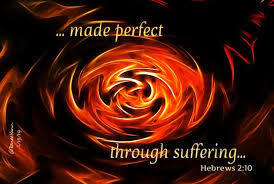
For in subjecting all things to (mankind), He left nothing that is not subject to him. But now we do not yet see all things subjected to him. 9 But we do see Him who was made for a little while lower than the angels, namely, Jesus, because of His suffering death crowned with glory and honour, so that by the grace of God He might taste death for everyone. 10 For it was fitting for Him, for whom are all things, and through whom are all things, in bringing many sons to glory, to perfect the Archetype of their salvation through sufferings. 11 For both He who sanctifies and those who are being sanctified are all from One; for this reason He is not ashamed to call them brothers and sisters (Heb2:8-11)
Firstly note in the opening two verses, the transition of the personal pronoun (him) in v8 to a capitalized version (Him) in v9. This affirms what I wrote in the previous post that vv5-8 is referring to humanity, not exclusively to Jesus . Most bible versions have this right but not all – the latter presumably having a problem with the implication that all that has been created (including the angels) will be under mankind’s control. As I explained, this has all and everything to do with Jesus and how God’s elect as a kind of first fruit for humanity shall relate to the appointed Lord of the Universe.
ἐξ ἑνὸς ?
To be writing as I do I certainly believe myself to have received prophetic insights, but there are aspects of this passage that go beyond my knowledge. That especially applies to verse 11 where the writer to the Hebrews states that Jesus and His disciples are ἐξ ἑνὸς – i.e., either they are both the same or derive from the same source which (in view of LJC) can only be God. So are human beings inherently divine? – one would imagine not. Yet they are made in the image of One who is, and through sacramental participation God’s elect are already “partakers of the divine nature” (2Pet1:4).
In terms of destiny “it has not yet been revealed what we shall be but we know that when He appears we shall be just like Him”. (1Jn3:2). As affirmed in the previous post, mankind’s destiny (certainly for the human elect) is inextricably linked to that of Jesus Christ, Lord of the Universe. They are to be as Man and Wife, once the latter has made herself ready (Rev19:7). Likewise, they are kith and kin, for it is also to be noted from verse 11 that the reason Jesus is not ashamed to call his disciples brothers is because (“for which reason”) He and they are ἐξ ἑνὸς .
The NEED for suffering
What has been made clear to me yet appears a mystery to most Christians is the essentiality of sin and suffering for those who are to be raised to glory. Paul affirms it, Hebrews indicates why, and points to the fact that this principle even applied to our sinless Saviour. Verse 9 states explicitly that it was because of Jesus’ suffering death that He was crowned with glory and honour. What is more: “It was fitting for Him, for whom are all things and by whom are all things, in bringing many sons to glory, to make the Archetype of their salvation perfect through suffering (v10). And later in Hebrews:
“Though He were a Son, He learned obedience by the things which He suffered, and having been perfected He became the author of eternal salvation for all who obey Him” (Heb5:8-9)
In Jesus’ case His suffering could have nothing to do with personal purification, for He was without sin. It pertained to His personal capacity and office, especially that of High Priest:
“Therefore, in all things (Jesus)had to be made like His brethren, that He might be a merciful and faithful High Priest in things pertaining to God, to make a propitiation for the sins of the people, for in that He Himself has suffered, being tempted, He is able to aid those who are tempted” (Heb2:17-18)
His awareness and personal experience of human suffering also prepares Him for His role as Supreme Judge of humanity. It set a pattern and example for those who as co-heirs must support Him as priests, kings and judges; they are to share in Christ’s glory but must firstly share His suffering:
Now if we are children, then we are heirs: heirs of God and co-heirs with Christ; if indeed we share in His sufferings in order that we may also share in His glory (Rom8:17)
The PURPOSE of suffering
Regarding the previous few posts, this is the advantage that human beings have over the angels of heaven: a personal day-to-day experience of sin and suffering. Such might not be advantageous if human destiny were to be confined to the spiritual realm: a blissful stasis beholding the vision of God’s glory, wonderful though that is for those who have “fallen asleep” as Scripture describes the temporary separation of body and spirit in heaven.
But the emphasis from the Old Testament prophesies, the gospels, the epistles and Revelation as far as the next age is concerned is for the elect of God to be “the children of the resurrection” (Lk20:36). For the believer’s destiny once resurrected does not merely consist in beholding but participating with God in eternal union with His Son. But as with any marriage, howsoever the Bridegroom may relate to His Father through eternity so must His Bride for they are now in union; and whatsoever His Son’s activity and domain, so shall His co-heirs share in it.
The Little Book of Providence:
Free PDF https://richard-777.blog/wp-content/uploads/2025/01/b5b48-cnu.pdf
Large-print version suitable for mobiles https://richard-777.blog/wp-content/uploads/2025/01/5d6bc-mnu.pdf
 The Little Book of Providence