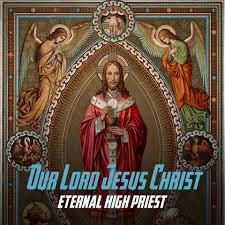
3 Therefore, holy brothers and sisters, partakers of a heavenly calling, consider the Apostle and High Priest of our confession: Jesus; 2 He was faithful to Him who appointed Him, as Moses also was in all His house. 3 For He has been counted worthy of more glory than Moses, by just so much as the builder of the house has more honour than the house. 4 For every house is built by someone, but the builder of all things is God. 5 Now Moses was faithful in all God’s house as a servant, for a testimony of those things which were to be spoken later; 6 but Christ was faithful as a Son over His house—whose house we are, if and only if** we hold firmly to our confidence and the boast of our hope to the end (Heb3:1-6).
A short passage that provides enlightenment concerning Jesus as High Priest as well as those over whom He presides in that capacity. Starting with the latter, they are the holy ones or “saints”, by which is denoted that they have been set apart by God. Also, that they are not merely “justified sinners”, but a people who are morally and characteristically being conformed to the image of Jesus Christ (Rom8:29). These chosen ones are “partakers of a heavenly calling (κλήσεως)” – a Greek word that also has the sense of being invited, the “heavenly” reference indicating by Whom.
The nature of our calling
Referring back to our considerations of Paul’s writings and his frequent direct or more often indirect references to predestination, the calling/invitation is the aspect of gospel salvation that is “all of grace”. That it is not say it is a matter of random chance, for “whom He foreknew He predestined to be conformed to the image of His Son”(Rom8:29). The point Paul constantly makes is that election is not on the basis of inherent virtue or accumulated good works – that apostle, formerly Saul of Tarsus, being a classic example. He had been a fanatical Christ-hating saint-slaughtering zealot. Yet God foreknew that once confronted by the risen Christ and empowered by the Holy Spirit he would make a great apostle; for as Paul affirmed, he had been created for that very purpose.
As the writer to the Hebrews more than anyone makes clear, the calling/invitation and divine enabling (cf. Jn6:44) to embark upon the Way of the Cross is where the all-of-grace paradigm ends. Thereafter it is self-effort, self-discipline and faithfulness aided by the Holy Spirit and sacraments of grace. Thereby, in Paul’s language, one is enabled to “complete the course” and attain “the prize of the high calling of God in Christ Jesus” (Phil3:14). [I take every opportunity to re-iterate this truth, for it is vital to an appreciation of God’s justice and fairness towards all people, especially when taken in the context of the tripartite soteriology and resultant broader benign providence being outlined].
Christ uniquely qualified to be High Priest
The Lord Jesus Christ is the perfect High Priest and the previous post explained why: “Therefore, in all things (Jesus) had to be made like His brethren, that He might be a merciful and faithful High Priest in things pertaining to God, to make a propitiation for the sins of the people, since that He Himself has suffered, being tempted, He is able to aid those who are tempted” (Heb2:17-18).
Moses the servant, Christ the Son
The passage then compares Jesus with Moses. The latter was a great leader, who also effectively acted as a high priest for the people under his charge. He interceded for them, attempted to propitiate God’s anger for their frequent disobedience and faithlessness. He even offered to take God’s threatened punishment of the people upon himself: “Moses returned to the Lord and said, “Alas, this people has sinned a great sin. They have made for themselves gods of gold. But now, if you will forgive their sin—but if not, please blot me out of your book that you have written.” (Ex32:31-32).
So in those regards, Moses might be seen as a “type” of Christ, but the writer to the Hebrews makes clear who is by far the greater of the two. Both were appointed by God (v2) but whereas Moses had been faithful as a servant of God’s house, Jesus had been faithful as a Son over His. More fundamentally, the house that Christ rules over could never have come into existence if it were not for the achievements of its Leader and Saviour.
The House of the Lord
For as considered in the previous post/passage, Jesus was the Archetype and author of His people’s salvation, especially through the suffering that He endured on their behalf (2:10). It is His house and He effectively was its builder, “whose house we are, if and only if** we hold firmly to our confidence and the boast of our hope to the end” (v6), which rather goes back to the points being made in my second paragraph.
** εἴπερ – an infrequently used strengthened conditional clause meaning “if it is indeed the case that” or in modern parlance “if and only if”…
Author’s Facebook page HERE
 The Little Book of Providence