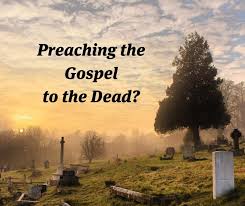
4 Therefore, since Christ has suffered (death) in the flesh, arm yourselves also with the same purpose, because the one who has suffered (death) in the flesh refrains from sinning, 2 so as to live the rest of the time in the flesh no longer for human lusts, but for the will of God. 3 For the time already past is sufficient for you to have carried out the desire of the Gentiles, having pursued a course of orgies, lusts, debauchery, drunken revelry and abominable idolatries. 4 In all this, they are surprised that you do not run with them in the same excesses of debauchery, and they slander you; 5 but they will give an account to Him who is ready to judge the living and the dead. 6 For the gospel has for this purpose been preached even to those who are dead, that though they are judged in the flesh as people, they might however live in the spirit according to the will of God (1Pet4:1-6).
The Christian life can be defined in many ways and Peter’s opening statement provides a key element to what should be the believer’s mindset. That is to live as one who has “died to the flesh” resulting in “πέπαυται” with regard to sin. Some bible versions (e.g. KJV, NASB) translate the Greek as “ceased from sin”, which is fine as long as it is understood that it is we who stop sinning, not (as I once imagined) that because Christ has died for me, I am no longer regarded as sinning even when I do. Not that any believer can go on to live a perfectly sinless life, but that he/she as far as possible refrains from wilful sin. Or as Peter perfectly expresses the matter, the true believer “lives the rest of the time in the flesh no longer for human lusts, but for the will of God” (v2).
The unbeliever’s nature
In terms of what the apostle goes on to write concerning his readers’ previous life as Gentiles it needs to be remembered that this, like all epistles, is a pastoral letter to specific communities, not an evangelistic sermon. “Orgies, lusting, debauchery, drunken revelry and abominable idolatries” is absolutely not a valid depiction of the typical non-Christian’s life style or mindset. But clearly it had been in the case of some or perhaps many of the believers to whom the apostle was addressing or he would not have written it. But as Paul in particular has made clear, what is true of all unbelievers including the many who seek to live decently and worthily, is that as long as they are in human flesh they can never be entirely free from its dominating influence. That is what Paul described as “the body of this death” (Rom7:24), being the worldly, materialistic and sometimes lustful inclinations of the bodily members as their senses are processed by the brain.
The preceding passage in Rom7 better described what Paul meant: “I find then the principle that evil is present in me, the one who wants to do good. For I joyfully agree with the law of God in the inner person, but I see a different law in the parts of my body waging war against the law of my (spiritual) mind, and making me a prisoner of the law of sin, the law which is in my body’s parts” (vv21-23). This earlier post explains this in more detail, but the point in the context of 1Peter is that this Rom7 scenario is not the case for the Christian, who as Paul followed up that statement affirmed “However, you are not in the flesh but in the spirit, if indeed the Spirit of God dwells in you” (8:9).
The lust of the flesh
Relatedly, whilst the Christian (hopefully) is not involved in orgies, drunken revelry and debauchery, the “lusts of the flesh” also pertain to more seemingly respectable activities and mindsets considered in Peter’s earlier teaching regarding worldliness, materialism and self-centredness. These are also not “in accordance with the will of God” (v6). That brings us on to the more contentious issue regarding the gospel being preached “even to those who are dead, that though they are judged in the flesh as people, they might however live in the spirit according to the will of God” (v6).
The principles and arguments concerning this concept were considered a couple of posts ago concerning Christ’s descent into Hell. Contrary to the many commentaries that would say otherwise, that certainly pertained to people who have died and whose spirits resided in Hell/Hades. And so, I am clear, does the reference here. As defined earlier, among other things the Christian is one who “lives the rest of the time in the flesh no longer for human lusts but for the will of God” (v2). Those who have not heard or responded positively to the gospel cannot entirely have done so, for such requires not only self-discipline but spiritual resources and graces that are only available to the Christian. But remember, God’s “elect” are those whom God has “predestined to become conformed to the image of His Son” (Rom8:29), and in Christ’s words “no one can come to Me accept they be drawn by the Father” (Jn6:44). As I trust I have shown, God’s elective choice of individuals to become intimately associated with His Son is a central tenet of New Testament teaching – reject that and you might as well dismiss the bible, starting with the Pauline epistles that are permeated with this doctrine.
God’s merciful intentions
Once the tripartite context of predestination has not only been proven but understood, it will be both unsurprising and expedient that the God who is described as love personified (1Jn4:8), the Saviour of all men (1Tim4:10) and the Desirer that all people are ultimately saved/healed and come to a knowledge of the truth (1Tim2:4) also is merciful towards the vast majority who have died devoid of the resources of gospel grace. I ask you, should not the spirits of these dead, having been judged and appropriately punished for avoidably sinful activities whilst in the flesh, have the opportunity to repent and submit to Christ’s Lordship in order that for the rest of eternity they might “live in the spirit according to the will of God”?
Of course they and indeed all of us will not always be in the spirit, for human destiny is to be reclothed in a physical framework that is not to be depicted as the “body of death”, into which every newly born spirit is currently planted in accordance with God’s will. Why the Father chose to act in such a way in response to the Fall has been made very clear to me and is set out in my book, together with how what many are likely to regard as speculative and overly optimistic on my part is entirely reconcilable with Scripture as a whole.
Author’s Facebook page HERE
 The Little Book of Providence