5 This is the message we have heard from Him and announce to you, that God is Light, and in Him there is no darkness at all. 6 If we say that we have fellowship with Him and yet walk in the darkness, we lie and do not practice the truth; 7 but if we walk in the Light as He Himself is in the Light, we have fellowship, the One with the other, and the blood of Jesus His Son cleanses us from all sin. 8 If we say that we have no sin, we are deceiving ourselves and the truth is not in us. 9 If we confess our sins, He is faithful and righteous, so that He will forgive us our sins and cleanse us from all unrighteousness. 10 If we say that we have not sinned, we make Him a liar and His word is not in us (1Jn1:5-10)
In terms of the post’s title, I have added a query mark in view of verse 7. Most bible versions and commentaries interpret John to be teaching that if we walk in the light it will result in true fellowship with our fellow believers. That is indeed the likely outcome, but the converse does not necessarily apply. A person can appear to be entirely at one with the rest of his church congregation and yet be walking in darkness – for example whilst living in a secret adulterous relationship, something I have personally encountered in the past. This of course cannot be so with God and our relationship with Him – nothing can be hidden, He knows our hearts. That is one of the reasons that, along with the Amplified Bible, I take John to be referring in verse 7 to our fellowship with God.
That is also more logical in the context of the previous verse: “If we say that we have fellowship with (God) and yet walk in the darkness, we lie and do not practice the truth”. I suspect the translators and many Christians will have a problem with the concept of fellowship with God – He is hardly our fellow; the term implies an equivalence that is far from the case. Yet clearly it wasn’t a problem for John in verse 6, but then he was writing in Greek. “κοινωνίαG2842” generally translated as “fellowship” is derived from κοινωνόςG2844 meaning partnership, participation or sharing. Yet that is still a staggering thought – you or I becoming partners and participators with the One whom the writer to the Hebrews describes as the Majesty on High (1:3 & 8:1).
As my earlier posts have been intimating, that is indeed our future destiny if we are true believers. Yet as John is indicating, such κοινωνία/κοινωνός can start now, at least in measure. For as considered in the previous post regarding “the Word” and the comprehensive deity of the Lord Jesus Christ, He regards us as His own kith and kin – “For both He who sanctifies and those who are sanctified are all from one God; for this reason He is not ashamed to call them brothers and sisters” (Heb2:11).
Divine fellowship
Do not mistake me, fellowship with other believers is crucial, for Jesus Himself said “Just as I have loved you, so you also should love one another – by this all people will know that you are My disciples if you have love for one another”. The point I am drawing out is that John is saying something beyond this in his first epistle. He is introducing a concept which is staggering and incredibly exciting. For those who regard the idea of fellowshipping with God as presumptuous, carefully re-read the letter to the Hebrews, especially with regard to our relationship with God, Jesus and the angels that results from “the Word’s” incarnation as a Man. My earlier post expounds upon this wondrous theme, aspects of which pertains to future glory. But as I am ever endeavouring to internalize myself, κοινωνία with God starts here and now!
As John makes clear, the obvious hindrance to such fellowship is our sinful nature, which as long as we are in mortal flesh cannot be entirely eradicated. Certainly, if we continually walk in darkness, failing to confess and repent of serious sin, we may indeed fool our fellow believers and seemingly relate perfectly well with them, but divinely related κοινωνία becomes quite impossible. However, “if we walk in the Light as He Himself is in the Light, we have fellowship, the One with the other, and the blood of Jesus His Son cleanses us from all sin” (v7).
Walking in the light involves being faithful to the teaching of Christ, moral integrity and honesty. As John goes on to write, the latter involves acknowledging our failings: “If we say that we have no sin, we are deceiving ourselves and the truth is not in us” (v8). We need to confess our sins as soon as we recognize them. But given the nature of our relationship with God (κοινωνία), that does not necessitate the intercession of a priest, at least for venial sin (cf. 1Jn5:16). [Mortal sin requiring reconciliation with God and His Church is another matter and for another post].
The sacrament most holy
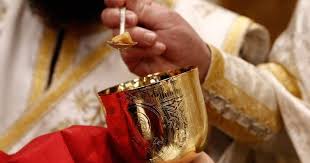
Speaking of such sacraments, John affirms it is the blood of Jesus, God’s Son that cleanses us from all sin– again with the proviso that we are walking in the light (v7). The Greek word translated as “cleanses” is a present continuous tense – it does not pertain to a one-off event. This indirectly links back to our considerations in the previous post – eternal life being a spiritual quality of life that non-believers do not possess. That is affirmed by Jesus’ statement: “Truly, truly, I say to you, unless you eat the flesh of the Son of Man and drink His blood, you have no life in yourselves (Jn6:53). That verse in turn indicates the means by which Christ’s blood is able to provide ongoing cleansing for sin. Some will understand this and be sure to attend the appropriate means of grace. Regrettably others will not, such as myself for the first 28 years of my Christian life. An earlier post provides some historical background to the obscuration of this issue and briefly testifies to how I came to a better understanding of the blessed sacrament; one that pertains to our sanctification and spiritual vitality, both of which are a prerequisite for fellowship with the Divine.
Author’s Facebook page HERE
 The Little Book of Providence