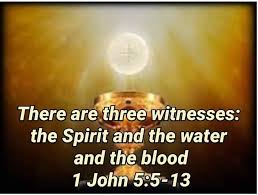
5 Who is the one who overcomes the world, but the one who believes that Jesus is the Son of God? 6 This is the One who came by water and blood, Jesus Christ; not in water only, but in water and in blood. It is the Spirit who testifies, because the Spirit is Truth. 7 For there are three that testify: 8 the Spirit and the water and the blood; and the three agree. 9 If we receive the testimony of people, the testimony of God is greater; for the testimony of God is this, that He has testified concerning His Son. 10 The one who believes in the Son of God has the testimony in himself; the one who does not believe God has made Him a liar, because he has not believed in the testimony that God has given concerning His Son. 11 And the testimony is this, that God has given us eternal life, and this life is in His Son. 12 The one who has the Son has the life; the one who does not have the Son of God does not have the life (1n5vv5-12).
Water, blood and prepositions
In terms of verse 6 I have highlighted the prepositions pertaining to John’s references to water and blood, for arguably they are significant. The argument being whether or not the apostle is referring (among other things) to the Eucharistic sacrament when he identifies the three witnesses or “testifiers” to Christ’s coming – the Spirit, water and blood. Taking the verses in sequence, the first preposition used is διά (v6a), rightly translated as “by” or “through”, for it denotes the channel of an act.
The related issue concerns John’s reference in verse 6 to Jesus “who came” or more literally “having come” – ἐλθὼν being an aorist participle that does not specify duration. We (Christians) know Jesus came to earth, but do the Spirit, water and blood testify that in some sense He is still present? – by the working of the Holy Spirit in believers’ lives, by the water of baptism and (more controversially) by His mystical presence in the species of the Eucharist? I have become clear that is the case.
John makes a point of emphasizing that (the witness to Christ’s presence) is not in water only, but in water and in blood. Again, I have emphasized the preposition, for it is no longer διά (by or through) but ἐν, meaning “in” – denoting position, a relation of rest. This is not reflected in all the translations (e.g. the NASB who stick with “by”), but is clear in the Greek interlinear. Many commentaries try to explain John’s emphasis on the blood’s witness being to counter earlier heresies questioning the full humanity and divinity of Christ. That may in part be the case but the point about the prepositions still stand.
Life in the Son
The other point I would make from this text concerns that to which I frequently refer – namely the New Testament’s reference to life, or eternal life. “God has given us eternal life, and this life is in His Son. The one who has the Son has the life; the one who does not have the Son of God does not have the life”(vs11b-12). This time I have highlighted the verb – “has” (Greek: ἔχει). Life/eternal life pertains to what one currently possesses – not going to heaven when you die but what is the believer’s possession now, for he/she is no longer “dead in trespasses and sins” (Eph2:1&5) but has been “raised to eternal life”. That is so as to relate to and serve the living God whilst still in mortal flesh, and by divine teaching and the Holy Spirit’s enabling become fitted for a glorious inheritance in the ages to come (cf. Rom8:17).
Author’s Facebook page HERE
 The Little Book of Providence