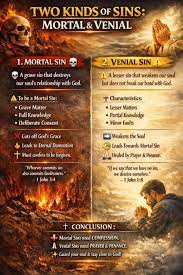
16 If anyone sees his brother sin that does not result in death, he shall ask and God will, for him, give life to those who commit sin not leading to death. There is sin leading to death; I am not saying that he should pray about that. 17 All unrighteousness is sin, but also there is sin not leading to death. 18 We know that no one who has been born of God (continually) sins; but being born of God, God keeps him, and the evil one cannot lay hold on him. 19 We know that we are of God, and that the whole world lies in the power of the evil one. 20 And we know that the Son of God has come, and has given us understanding so that we may know Him who is true; and we are in Him who is true, in His Son Jesus Christ. This is the true God and eternal life. 21 Little children, guard yourselves from idols (1Jn5:16-21).
Surely, sin is sin?
My earlier understanding and assertion as an Evangelical had been that sin is sin. That is, as far as God was concerned, it mattered little whether one merely “missed the mark” of God’s glory or whether one did what would be hateful and abhorrent in any decent person’s estimation. Either way (I had understood), God was distinctly aggrieved and determined to punish the offender severely. I now know that is far from the truth and a perversion of divine justice: God (or more specifically Jesus Christ Whom God has appointed to judge the living and the dead – Acts10:42) regards these matters much as any saintly person would, or rather vice versa. For man was made in God’s image, and in those predestined to be saints, that image is being restored fully, to reflect that of the Universal Judge (Rom8:29). And that is just as well in view of what lies in store for them (cf. 1Cor6:3; Rev3:21).
Distinguishing sins
In terms of differentiating sin or particular sins, John is here indicating the difference to be that between life and death. And that surely must relate to spiritual life/death. For whilst there are a few isolated examples of believers’ sins resulting in immediate physical death (most notably Ananias and Sapphira – Acts 5), during my 50+ years as a Christian (Evangelical then Catholic) I have known quite a number of established Church members who have grievously sinned, for example through human adultery, hardened malice towards another believer, priestly paedophilia or turning away completely from the Christian faith, yet none resulted in imminent physical death or even illness.
As I have been outlining in recent posts, life/death in the New Testament often refers to our spiritual state; not (as I once understood) whether we are to be “saved” or “damned” but whether or not we currently possess eternal life (Jn17:3), i.e. have a living relationship with God, even whilst in mortal flesh. Such needs to be the case at physical death or if Christ returns prior to that, for a person to be defined as amongst “the elect” (cf. Mt24:31).
Mortal and Venial
In line with the Eastern Church, I am not inclined to prescribe a legalistic framework/listing of sins that are mortal or venial. Nevertheless, it is the case that some sins lead to spiritual death whilst others do not. But what a particular church might regard as lethal religious misdemeanours, it is evident from Jesus’ ministry and His frequent rebuking of the Pharisees that religious practice and ritual was far less important than the motives of the heart, especially justice, mercy and faith (Mt23:23).
Nevertheless, given that this is virtually the only reference in the New Testament to mortal versus venial sins, it would have been helpful if John had provided some practical examples. Given the literally life and death importance of the subject, I’m sure he would have done so verbally, but such instruction is not recorded in our canon of Scripture. So much for “Sola Scriptura” – once again we are reliant also on Tradition and the Church to function as the “pillar and ground of the Truth” (1Tim3:15), just as God intended.
Those who continually sin.
In terms of the rest of John’s teaching that concludes his first letter, it is generally rightly understood that his reference to those who are of God “not sinning” pertains to the fact that they do not sin continually (v18). For those who are “of God” are distinguishable by the fact that they have a working conscience. That does not prevent them from ever sinning – they just feel guilty and uncomfortable when they do. What is not generally understood, especially in the churches I once frequented is that such a dichotomy is not Christian versus non-Christian but those who are “of God” verses the children of the devil, true Christians being a subset of the former, and a proportionately small one at that.
The really good news
That is indicative of not two but three soteriological categories of people, which is undoubtedly the major and most propitious aspect of what I am endeavouring to impart. Apart from its wondrous (vastly broader benign) providential implications, such a trifold categorization is the only way by which predestination can be reconciled with free will. Still more importantly, it explains how the biblical certitude of divine election can be reconciled with a God who, as the epistle under consideration has confirmed, is love personified (4:8). This long awaited resolution was explained in a little more detail in this earlier post, whilst its context within Scripture and the Gospel as a whole has been set out in The Little Book of Providence.

