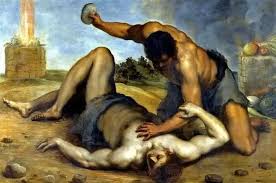
Thesis #3 of 95 – Abel was not “saved” by anticipating Calvary when he sacrificed an animal (Gen4), he remained justified within a de facto covenant for fallen humanity by exercising faith/faithfulness, offering the best of his produce with a good conscience.
Thesis #4 of 95 Cain defaulted from this Universal Covenant after killing his brother
Thesis #5 of 95 Such an inclusive covenant is indicated by the fact that Cain was neither entirely alienated from God nor cursed by Him until after his fratricide
BIBLICAL REFERENCE
Gen4:13-16 Cain said to the Lord, “My punishment is too great to bear! Behold, You have driven me THIS DAY from the face of the ground; and from Your face I will be hidden, and I will be a vagrant and a wanderer on the earth, and whoever finds me will kill me.” So the Lord said to him, “Therefore whoever kills Cain, vengeance will be taken on him sevenfold.” And the Lord appointed a sign for Cain, so that no one finding him would slay him. Then Cain went out from the presence of the Lord, and settled in the land of Nod, east of Eden
COMMENTS
Whilst there may have been a prophetic connotation to Christ’s Passion, the idea that Cain and Abel were expected to anticipate a future Sacrifice for sin by killing an animal is unsustainable. Cultic sacrifices were not clearly established as a religious system until the Law of Moses. Even Jesus’ own disciples had no idea that their Master and Saviour of the world was to die and become a Sacrifice for sin, still less would the immediate descendants of our first parents have such an understanding. Apart from which, no one in the Old Testament is declared to be justified based on offering an animal sacrifice, so Abel cannot be an exception.
Abel exercised faith and produced fruit in the form of good works. Abel didn’t “get saved”, he remained accepted (justified) and was acknowledged as righteous within the Universal Covenant. Cain reprobated (became rejected) and was brand marked for Satan, and as a warning to those who would cross him. That was not at the point he failed to offer his first-fruit in sacrifice, for although God was not pleased with his offering, He still held out an olive branch. Rather he was called to account immediately AFTER he had killed his brother, showing himself to be psychopathic: devoid of conscience or compassion – as later categorized, a child of the devil (cf. 1Jn3:12).
~ ~ ~ ~ ~ ~ ~ ~ ~ ~~~~~~~~~~~~~~~~~~~~~~~~~~~~~~~~~~~ ~
What’s this?
I am briefly commenting on each of the 95 theses that summarize key outcomes from The Little Book of Providence. These were first published on Halloween 2017*, so I suspect most current visitors to my website’s Homepage (latest posts) will not have seen them… [*31/10/17 being the 500th anniversary of Martin Luther’s version].

